
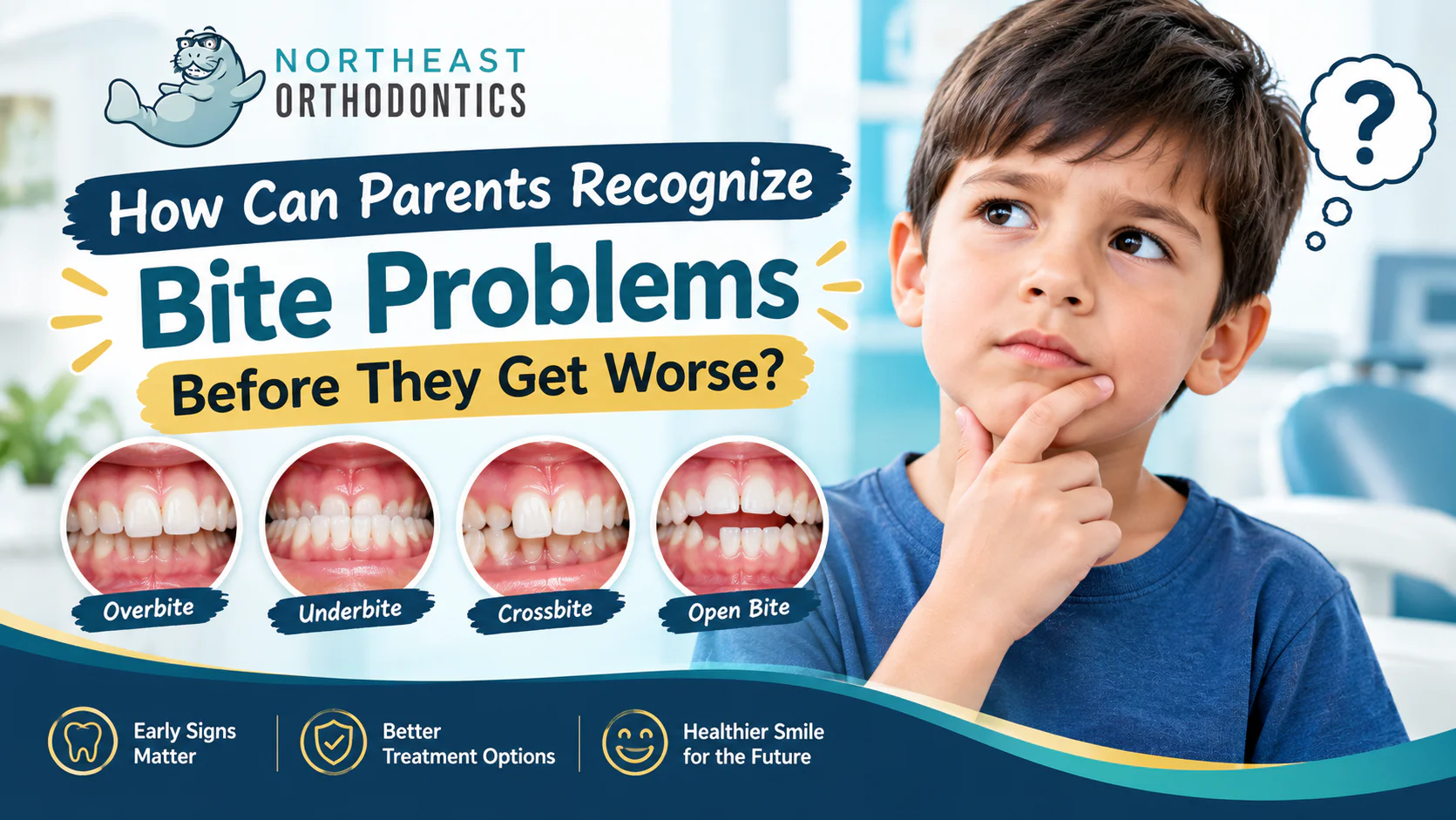
Parents can notice bite problems early, before they get worse. They can spot early signs in their child’s daily habits, like chewing on one side, breathing through the mouth, or having a persistent lisp. These symptoms can appear even before a crooked tooth becomes visible. As your child grows, their jaw can respond well to early guidance. Noticing these signs early can make treatment easier later.
This article explains what to look for at each stage and when to seek a professional opinion. At Northeast Seminole, we can help you understand whether your child has a serious bite problem.
What Does a Healthy Bite Look Like in a Growing Child?
As your child grows, a healthy bite means that the upper front teeth are slightly in front of the lower front teeth. When the jaw is closed, the back teeth should come together comfortably. There should be enough space for the teeth to fit properly. You should not notice any clear crowding, overlapping, or unusually large gaps. A child’s bite changes because baby teeth fall out and adult teeth grow in. Because of this, some irregularity is normal and doesn’t always mean a longer-term issue.
If you know what is normal for your child’s age helps you notice when something is not right. This can help you stop worrying about small changes. A dentist who sees your child regularly can usually tell you what changes are normal as they grow. They can also notice anything that needs extra care.
How Can an Overbite or Underbite Affect a Child’s Development?
An overbite or underbite can affect a child’s development by changing how they chew and speak. They can also influence jaw growth over time, since both conditions change how the upper and lower teeth meet.
An overbite occurs when the upper teeth sit well in front of the lower ones and can make front teeth more likely to chip or fracture during a fall. An underbite, where the lower teeth sit in front of the upper ones, can make chewing certain foods more difficult. It can sometimes affect how clearly a child pronounces certain sounds.
These two conditions can affect how your child’s face and jaw grow over time. This is because the muscles and bones respond to how their teeth connect every day. If you catch both early, your dentist will have more options to gently guide growth. This may be easier than correcting a more established habit later.
What Are the Signs of a Crossbite or Open Bite?
The signs of crossbite include the upper back teeth biting inside the lower teeth on one side. As a result, your child’s jaw may look slightly uneven when they bite down. You may also notice an open bite, a visible gap between the upper and lower front teeth. Even when the back teeth close fully, this gap can remain. This can happen because of too much thumb-sucking or pacifier use. Both conditions tend to be easier to spot when you ask your child to bite down normally and look directly at how their front teeth line up.
Can Difficulty Chewing or Biting Signal an Orthodontic Problem?

Difficulty chewing or biting can be a sign of an orthodontic problem. This is especially true if your child often avoids crunchy foods or chews on only one side. They may also move their jaw sideways, grinding food instead of chewing normally.
If your child regularly bites the inside of their cheeks or lips, this may signal a bite problem. This can mean your teeth aren’t lining up properly during normal chewing. These signs may appear before any visible misalignment happens. Even if your child’s smile seems fine, it’s still important to watch for these signs.
Mealtime habits are usually easier to notice than minor alignment issues. This can be helpful if you are not sure what a healthy bite should look like. If your child chews on one side for more than a few weeks, you should consult a dentist. It could be more than just a weird habit.
Can Bite Problems Change as a Child’s Jaw Develops?
Bite issues can change as your child’s jaw develops and permanent teeth come in. They can improve, but they can also get worse. Once all adult teeth have developed, some minor irregularities will resolve on their own. Over time, other problems can become more obvious. This is especially true for issues relating to jaw width or prolonged oral habits. That is why dentists usually advise patients to watch their developing bites over time. Not every irregularity will resolve on its own, and not all of them need treatment.
If habits like thumb-sucking or pacifier use continue after age 3 or 4, they can keep pushing the upper teeth forward and change the shape of the palate. This can happen even if the rest of the bite develops normally. If baby teeth are lost too soon because of decay or damage, nearby teeth might move into the empty gap. This can block the way for permanent teeth to come from underneath.
When Should Parents Have Their Child’s Bite Evaluated?
Parents should have their child’s bite checked at the age of seven. Because children usually have a mix of baby and adult teeth at this age. This makes it easier for specialists to spot small jaw-growth issues early.
An early evaluation does not mean that treatment will start soon. It simply lets an expert see how the bite’s developing and treat only if needed. So, if parents notice signs like mouth breathing, grinding, or visible misalignment, they do not have to wait until their child is 7 years old to get an opinion.
Frequently Asked Questions
How can I tell if my child has an abnormal bite?
You can look for signs like chewing only on one side, mouth breathing, or a persistent lisp. You may also see a visible gap between the front teeth when your child bites down. A dentist can help you find out whether you have a real bite problem.
At what age should a child have a bite evaluated?
The American Association of Orthodontists recommends a first orthodontic evaluation by age 7. This time helps specialists find jaw growth issues while both baby and adult teeth are still present.
Can a child’s bite correct itself as they grow?
Some small bite irregularities may correct on their own as your child grows. This can happen as permanent teeth come in and the jaw grows. However, some bite issues are related to jaw width or habits like thumb-sucking. These may need professional guidance to improve.
Can an untreated bite problem affect eating or speaking?
An untreated bite problem can make some foods harder to chew. It may also affect how clearly a child pronounces certain sounds. These functional effects usually appear before any visible misalignment.
Do all bite problems require braces?
Not every bite problem needs braces. If you find it early, simpler treatment or natural correction may be enough as the permanent teeth come in. The best way to know what a specific case needs is to have a dental professional check it.
What happens during an orthodontic bite evaluation?
During your orthodontic bite evaluation, your dentist will look at your child’s teeth and how the jaw comes together. They may also take X-rays to see how the permanent teeth are developing under the gums. Based on their findings, the provider can explain whether your child needs monitoring or treatment.
Final Thoughts
You can notice bite problems early by watching small, everyday signs. Observe how your child chews, speaks, breathes, and sleeps, and also how their teeth line up. Many bite issues are easier to treat when a child’s jaw is still developing. That is why guidelines suggest having a first evaluation around age 7.
If you see anything unusual, Northeast Seminole can help you decide whether it is worth looking into more. So, schedule your consultation with us today to get your child’s bite checked.


